Hotel segmentation connects guest behavior with pricing, marketing and operations, helping teams focus on valuable audiences and adapt as demand changes.

Hotel market segmentation is most useful when it changes a decision: which guests to target, what to offer them, how to price a room, or when to schedule staff. The work starts with booking and guest data, then connects that evidence to choices across marketing, revenue management and hotel operations.
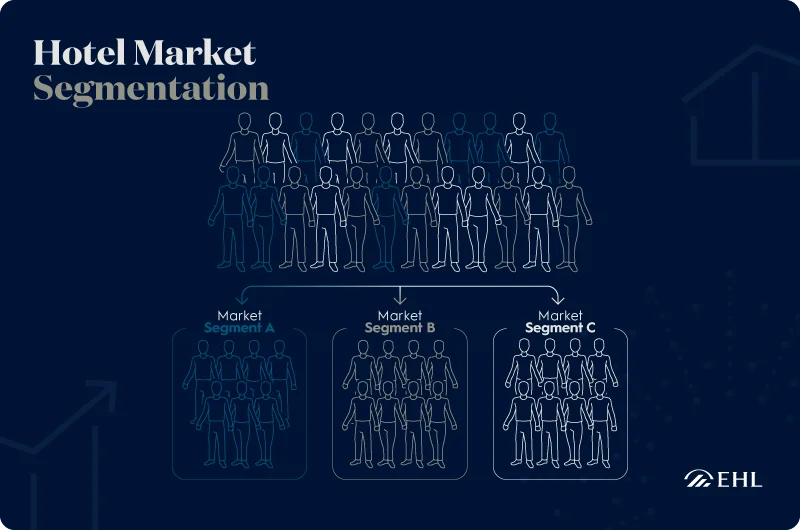
That makes segmentation more practical than a set of audience personas built from assumptions. It groups actual prospects and guests by shared traits and behaviors, so teams can see which audiences book, what they value and how their stays affect the business.
Start with booking patterns, then add context
Hotels commonly sort bookings into groups based on how they’re made and the rates attached. These categories offer a useful first pass, but they don’t explain everything about a guest. A corporate traveler might attend a convention, for example, while another business guest books independently. Adding purpose of travel, guest behavior and origin can make the picture more useful.
Transient travelers book individually, often at non-discounted rates, and may be traveling for business or leisure. Leisure guests in this category are also known as free independent travelers, or FITs. Their booking channels, trip lengths and reasons for travel vary widely, so hotels may need subgroups such as solo business travelers, walk-in guests and couples.
Group bookings are made for people traveling together. They may involve room blocks, a group rate or added benefits such as breakfast. A group often has one organizer as its main contact. Some hotels also track SMERF groups—social, military, educational, religious and fraternal organizations—as a distinct audience.
Corporate negotiated rates, or CNRs, cover business travelers whose employers or travel management companies have arranged special rates. These guests may value convenience, including airport transfers, breakfast, reliable Wi-Fi and flexible booking. Locally negotiated rates, or LNRs, apply to businesses, associations or government organizations arranging stays for people attending events such as workshops and conferences.
Wholesale partners contract rooms at negotiated prices and resell them through travel agencies, tour operators, online travel agencies and other sellers. Discount bookings can come through loyalty programs, credit card rewards, traveler programs and promotions. A catch-all category may cover guests who don’t fit the other groups, such as people using employee or press rates.
Build segments that can guide a decision
Booking type is only one way to understand demand. Hotels can also group guests by geographic, demographic, psychographic and behavioral traits. Geography might cover a guest’s home country, town or region, along with cultural preferences. Demographics include measurable characteristics such as age, income, education, relationship status and family status. Psychographics describe interests, values, lifestyle and personality.
Behavioral data connects those traits to what guests actually do. Relevant signals include booking lead time and frequency, length of stay, cancellation and no-show rates, price sensitivity, room choice, travel party, travel dates, and response to upgrades or cross-sells. The booking channel matters too, but it differs from the distribution channel: a guest may discover a hotel through Google’s Hotel Search, then complete the reservation on the hotel’s website.
Travel purpose adds another layer. Meetings, incentives, conventions and exhibitions (MICE) can attract solo travelers or groups, and those guests may book through different rate types. A hotel could identify solo business travelers attending MICE events, corporate-rate business travelers, or local business guests staying for a convention on an LNR. Such detail helps only when it supports a distinct action.
A practical segment should fit the hotel’s brand and business goals, be measurable, have enough scale to justify tailored treatment, and remain stable long enough to act on. If a group is too small, hard to identify or short-lived, a bespoke campaign or operating plan may not pay off.
Use existing guest feedback as well as booking records
Hotels often already collect useful information throughout the reservation and stay. Booking systems can reveal channel, timing, rate and room preferences. Guest reviews, customer service tickets and calls, exit surveys, feedback polls, social media comments and forum posts can add context about why people chose the property and what they expect.
Combining traits can reveal audiences that broad booking categories conceal. A hotel might identify high-income, environmentally conscious leisure travelers from Sweden; families who reserve vacations months in advance; or solo travelers with lower incomes who prioritize experiences and seek discounted rooms. These examples show how geographic, demographic, psychographic and behavioral details can work together.
Once segments are defined, assess their contribution using measures such as Average Daily Rate (ADR), Revenue per Available Room (RevPAR), guest acquisition cost, profit per guest and total revenue. The purpose is to compare both the income a group brings in and the cost of attracting and serving it. Revenue alone may not show which guests are most valuable to the property.
Connect insight to hotel tools and operations
Segmentation relies on data collected across different systems. Marketing tools can track online behavior, campaign engagement and what people say about the hotel. Hotel systems add operational and commercial detail: a Property Management System (PMS) connects inventory with booking behavior, a Revenue Management System (RMS) helps assess segment performance, and a Customer Relationship Management system (CRM) can retain guest preferences over time. Hotel sales software, surveys and third-party data from OTAs and metasearch engines can fill in other parts of the picture.
The value comes when teams use those insights. Marketing can shape campaigns around what a group is likely to respond to and direct spend toward audiences that perform well. Revenue teams can adjust pricing and promotions to reflect price sensitivity, spending habits and interest in upgrades. Operations can anticipate busy periods and plan staffing and inventory accordingly.
Guest preferences can also inform service. Older travelers may prefer rooms near an elevator or on a lower floor; couples may favor quieter parts of the property. Tailored rewards can support loyalty, provided the hotel has a reliable way to recognize the guest and deliver the promised experience.
Links to broader hospitality coverage can help teams keep their assumptions current. See marketing in the hospitality industry, hospitality industry trends and social media trends for hoteliers.
Keep the model current and usable
Guest segments shift as travel patterns and preferences change. Regular reviews can show when an established audience is shrinking or a new one is becoming more important. A segmentation strategy needs ongoing data collection and analysis; it isn’t a one-time classification exercise.
There are practical limits. Privacy-conscious guests may share less information, and records spread across hotel systems, marketing platforms and third-party services can be difficult to analyze together. A useful setup should make it possible to bring the data into one view, produce clear reports and give teams findings they can act on.
Overlap is another challenge. A repeat corporate-rate guest may book a leisure stay on a later visit, leaving the hotel to decide which segment should guide the experience or marketing. Set prioritization rules so teams handle these cases consistently, and choose the category that best supports the decision at hand.
Finally, analysis needs a defined purpose and deadline. Without them, teams can spend too long sorting data without changing a campaign, staffing plan or inventory decision. Set an intended outcome—such as refining marketing, improving staff allocation or managing room inventory—and use the segmentation work to reach it.
The strongest approach is a working feedback loop: identify meaningful guest groups, measure their commercial contribution, apply the findings and review the results as booking behavior changes. Better segmentation won’t remove uncertainty from hotel demand, but it can give teams a clearer basis for deciding where to focus their next move.





Discussion
Sign in to join the discussion.